I was interviewed by Danièle Cybulskie for an episode of The Medieval Podcast, just in time for Valentine’s Day. The audio for this episode is here.
I was interviewed by Danièle Cybulskie for an episode of The Medieval Podcast, just in time for Valentine’s Day. The audio for this episode is here.
My review of Female-Voice Song and Women’s Musical Agency in the Middle Ages, edited by Anna Kathryn Grau and Lisa Colton has just appeared in Early Music. This book is part of the series Brill’s Companions to the Musical Culture of Medieval and Early Modern Europe and was published by Brill (Leiden) in 2022 at the somewhat eye-watering price of €215. Although reviewing large edited collections is quite a lot of work, I think it’s important to do so, especially when they’re pricey, as a way of informing potential readers of their contents in the hope that they might get a sense of whether to request their local library acquires the volume or, indeed, whether they fork out the money themselves. I think most universities libraries that teach music before 1500 and/or topics relating to women and music should probably buy this. I used the online version to write the review, which seemed pretty useful.
Early Music sent me a link, so you can see what I said about it in full: Elizabeth Eva Leach, “Female-voice song before 1500”. A review of Female-voice song and women’s musical agency in the Middle Ages, ed. Anna Kathryn Grau and Lisa Colton Brill’s Companions to the Musical Culture of Medieval and Early Modern Europe (Leiden: Brill, 2022), €215. Early Music, 51, no.4 (2023), 616–618.
This week, the Early Music Show on Radio 3 broadcast an hour-long programme about Guillaume de Machaut. David Gallagher devised the programme after reading my book and my colleague Dr Uri Smilansky joined me in fielding questions from Lucy Skeaping to give an introduction to Machaut and some of his music. The programme is available (in the UK at least): here (starts 2’2” into the track).
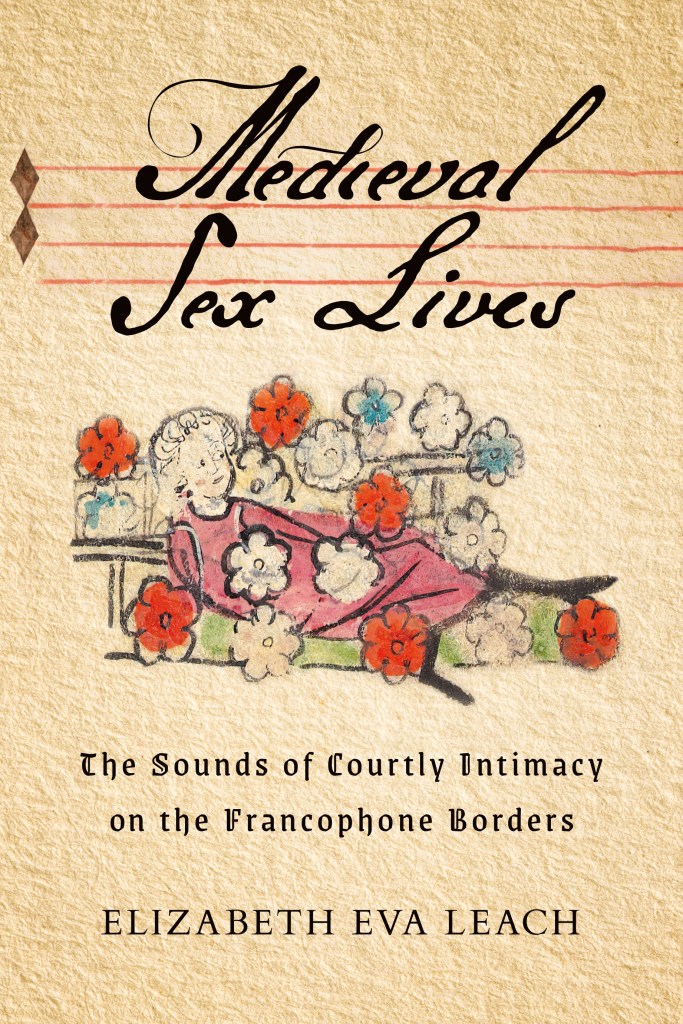
The publishers, Cornell University Press, have sent me some marketing materials for my new book, including a code for 30% discount on orders (scroll down to the end of the post). This post just gives a summary, the cover image, and a few sections from the author questionnaire they sent, which should give a flavour of what’s in the book.
Oxford, Bodleian Library MS Douce 308 preserves and re-copies the lyrics of over 500 songs, ranging from those written in the late twelfth century, to those composed only a few years before the manuscript was copied in the early fourteenth. Its lack of both musical notation and authorial attribution make it relatively unusual among Old French songbooks. Its arrangement by genre instead invites an investigation of the relationship between a long tradition of sung courtly lyric and the real lives of the people who enjoyed it, in particular their emotional, intimate, sexual lives, something for which little direct evidence exists.
With a focus on parts of Douce 308 not yet treated in detail elsewhere, Medieval Sex Lives offers an account of the manuscript’s contents, its importance, and likely social milieu, with ample musical and poetic analysis. In the process it offers new ways of understanding Marian songs and sottes chansons, as well as arguing for a broadening of our understanding of the medieval pastourelle, both as a genre and as an imaginative prop. Ultimately, Medieval Sex Lives presents a provocative speculative hypothesis about courtly song in the early fourteenth century as a social force, focusing on its ability to model, instill, inspire, and support sexual behaviours, real and imaginary.
This book arose from two different but related questions. First, I wondered why the sung lyric tradition of Western Europe that is generally called “courtly love had such a long and successful history. Second, I wanted to know why the unnotated songbook, Oxford, Bodleian Library MS Douce had bothered to preserve and re-copy the lyrics of over 500 such songs, ranging from those written in the late twelfth century, to those composed only a few years before the manuscript was copied in the early fourteenth. The lack of musical notation, which was never planned for its songs, makes this manuscriptunusual among Old French songbooks. Nonetheless, curating nearly 150 years of this long-lived tradition was clearly important to the patrons, compilers, owners, and users of this manuscript: but why?
Overall, the book challenges the idea that medieval song has nothing (or little) to do with the real lives of its audiences. Ch2’s proposal of love songs as sexual scripts is a controversial use of sociological theory to treat medieval literature. In Ch3 it offers a new way of approaching the sotte chanson (‘silly song’) as something not merely humorous or satirical, but as a potentially serious erotic possibility. Ch4 treats The Tournament at Chauvency from the perspective of sound studies. And Ch5 offers a controversial reading of the medieval pastourelle that firstly expands the definition of the genre to include songs rarely considered as pastourelles (but collected by Douce 308 as such), and secondly makes a difficult argument about some of them as offering fantasies of sexual domination and rape that might have appealed (and been useful) to some audience members, specifically women and queer people.

Residents outside North America should use 30% Discount Code: FFF23 and order online at combinedacademic.co.uk. Details on this PDF:
My article revisiting the dating, provenance and putting together of the manuscript Bodleian Library, Douce 308 has just appeared in the journal Speculum.
A brief overview of how medieval vernacular songs might inform and be informed by the social contexts that produced and consumed them.
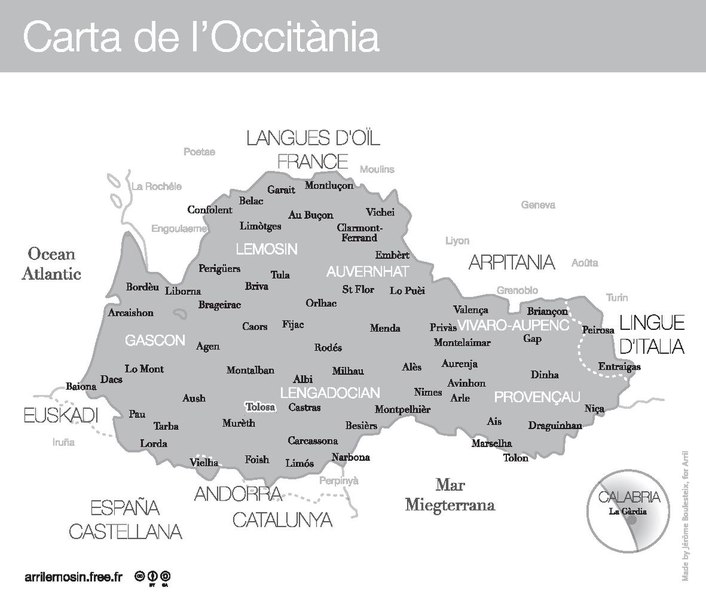
 This page hosts the audio for the first of my six ‘podlectures’ on Vernacular Song for List A Compulsory Topics (final year exams) at Oxford, delivered in this form because of ongoing restrictions caused by the current pandemic. It also gives links to some further reading and things mentioned in the audio.
NB: These podlectures form only part of the Vernacular Song topic as taught at Oxford, which is significantly supplemented by additional teaching in tutorials that demand extensive reading, essays, and presentations.
Good general reading
Referring to individual troubadour songs
On the music
Handy access to poems and translations
http://www.trobar.org/troubadours/
Information about recordings
http://www.medieval.org/emfaq/composers/trobador/
Information about manuscript images online
https://eeleach.blog/2012/01/17/the-wonders-of-gallica-some-troubadour-and-trouvere-sources/
TEST YOURSELF
Check you know what, who, or where these are:
This is the second podlecture and notes for my Machaut Course for Prelims Special Topics at Oxford.
Long-gestating co-editing project finally published as part of 700-page book.

 Elizabeth Eva Leach