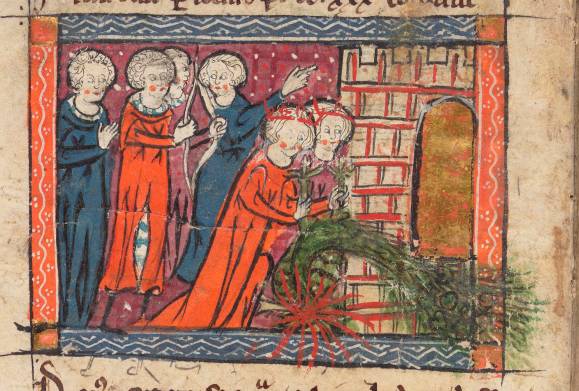
The first thing promised as part of my Leverhulme Major Research Fellowship is now done.
The complete images of the manuscript Oxford, Bodleian Library, Douce 308 are now online. The photography is funded by part of the Leverhulme Major Research Fellowship that I was awarded for 2015-18 specifically to write a book on this source and what it might tell us about the culture(s) of vernacular song in the few decades either side of 1300. (Some viewers may find it easier to use this alternative link to view the images.)
Many thanks to the Bodleian Library for their great efficiency in getting this done in time for the project start date (1 Oct 2015), which will mean I can get going straight away. I was interested to be asked whether I actually wanted to withhold the open-access web-mounting of the images until after I’d written my book. While I’m glad they asked, I think anyone’s going to ‘beat me’ to saying exactly what I would say about it, and my general view is the more the merrier on people using these images and finding things to say about this wonderful and complex source. I certainly won’t exhaust it!
I’m looking forward to blogging bits and pieces of interesting stuff as I go along.
 Elizabeth Eva Leach
10 replies on “Douce 308 complete images now online!”
[…] has appeared, my interest was sparked by n a refrain that is shared between this poem and one in Douce 308, the Tournament at Chauvency, where the singer is riding on a real horse. I’m currently […]
[…] This is the first of a series of posts giving the audio tracks and an introduction for the songs from Douce 308 that we workshopped in Oxford in March 2017 with graindelavoix and my students and postdocs. This first song, Amins ki est li muez vaillans (RS365) is a jeu-parti included seamlessly and without a new large initial letter, separate index listing, or number after JP27, thus given the number JP27a. As well as being found in an eight-stanza version in Douce 308, the text is found in TrouvC with empty staves and in TrouvO with notation, although with only the first three stanzas of text. The notation in TrouvO reveals that this is one of a number of texts that were sung to the tune of Bernart de Ventadorn’s widely copied song, Can vei la lauzeter, which is why listeners might recognize the melody. (The Douce 308 texts can be found starting on f.190v if you follow the link to the manuscript images here.) […]
[…] Trouvère I (GB-Ob Douce 308; also =motet MS D). See the blog post on this source here. […]
[…] Douce 308 (=TrouvI; MotD); early 14thC. The images are online: see my blogpost here! The Bestiary starts on f.86r. There is a listing for the MS on Arlima, which contains Jacques de […]
[…] repertoire in general. So, instead, I wrote an application for what would become my successful Leverhulme grant to work on Douce 308. I also wrote a short article on four of Blondel’s songs, laying out a basic method, and […]
[…] article on a two-stanza pastourelle in Douce 308 has just appeared in Plainsong and Medieval Music. Here with added sound […]
[…] Douce 308 complete images now online! […]
[…] Douce 308 complete images now online! […]
[…] Douce 308 complete images now online! […]
[…] Douce 308 complete images now online! […]